
★★★★★ 4.6/5
Trusted by vocal coaches and touring professionals
HME Foam technology
Designed in Stockholm
100-day money-back guarantee
5 Reasons Your Voice Wears Out Between Shows
(And why your technique isn't the problem.)
Plus the one thing vocal coaches and touring professionals are adding to their singing kit.

You land after the red-eye. Sound check is in four hours.
You try to warm up and the voice isn't there. Thick. Slow to respond. Range feels like it shrank overnight.
You've been blaming the schedule. The 8-show weeks. The late nights. The dry hotel rooms.
But there are singers on the same tour, doing the same schedule, who step off the plane and warm up like nothing happened.
The difference isn't talent. It isn't discipline. It's what they breathe for six hours at 35,000 feet.

01
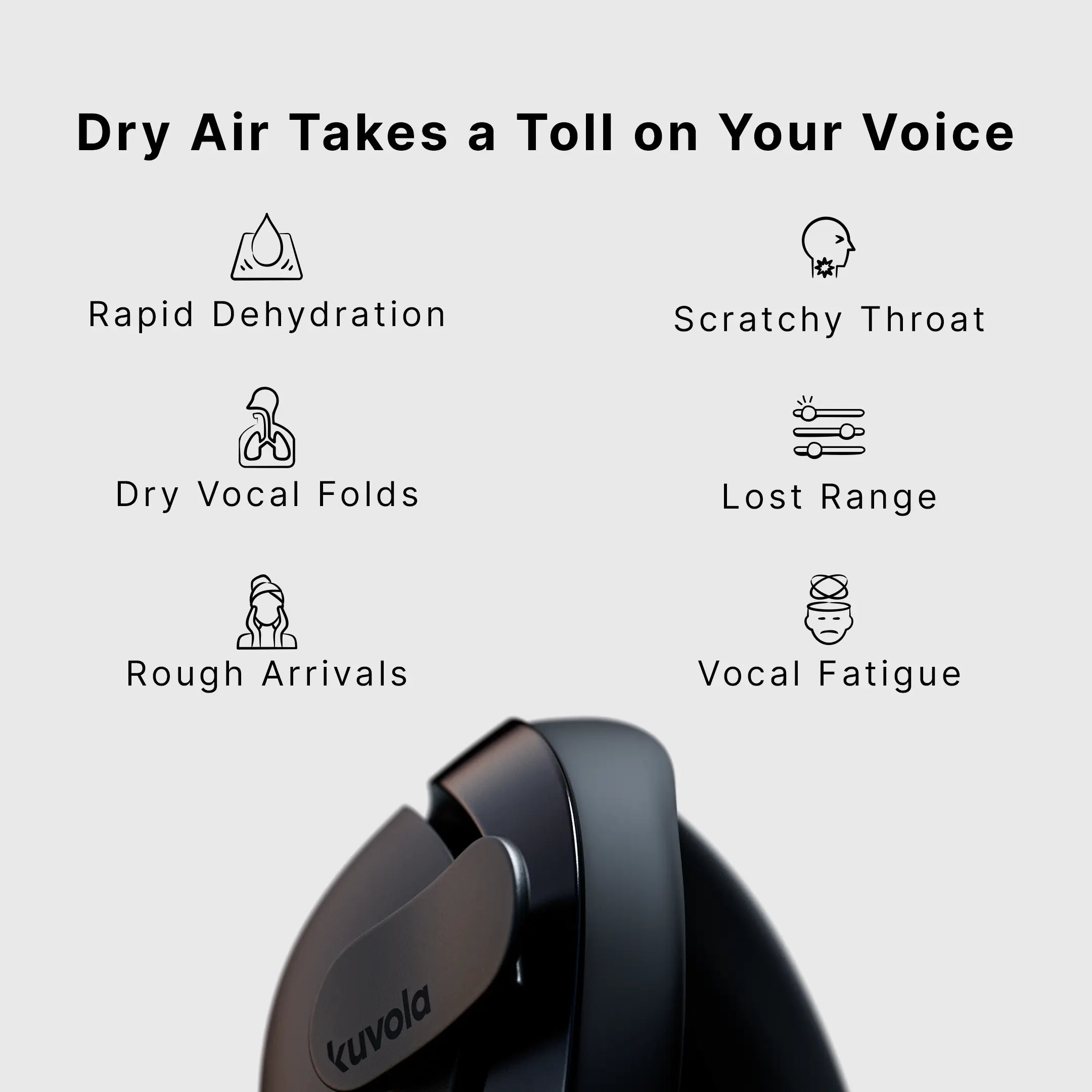
Cabin air is drier than the Sahara. Your vocal folds feel it first.
At cruising altitude, cabin humidity drops to between 5% and 12%. The Sahara sits around 25%. Your vocal folds need 40-60% humidity to vibrate freely and efficiently.
Every breath you take in-flight pulls moisture off the mucosal lining. Six hours of that, and the tissue that produces your sound is running dry.
Katelyn Swiader, MS Ed, explains how dry air affects your vocal folds.
02
Dry folds need more force to vibrate. Your range goes first.
03
It compounds. Every flight stacks on the last one.
A dry flight this week sits on top of last week's dry flight. By week three of a tour, the margin is gone.
Santino Fontana: "If something starts feeling weird one day, you've gotta deal with it that day or it's gonna turn into a bigger thing the next day."
Every touring season, more names join the injury list. Adele. Meghan Trainor. Sam Fender. Not bad technique.
The compound effect demanding schedules catching up.

04
Then the hotel finishes what the plane started.
You check in. The HVAC runs all night. Dry heating in winter, blasting AC in summer. You sleep eight hours breathing air barely more humid than the cabin you just left.
You wake up thick, raspy, slow to clear. The show is tonight. Between the flight and the hotel, that's 14+ hours of dry air before you even start warming up.
05
Water won't reach your folds in time. Your steamer can't come on the plane.
Drinking water hydrates systemically. Takes 2-4 hours to reach the vocal fold surface. Your throat coat tea isn't reaching your folds mid-flight either.
Your steamer needs setup, refilling, and power. And you're not allowed to use it on a flight. Can't use it while sleeping. Vocal rest protects from overuse but doesn't add moisture. You're still breathing 5-12% humidity air in silence.
Your current kit has a 6-12 hour gap: the flight itself. That's the hours nobody's covering.
"A performer's best friend."

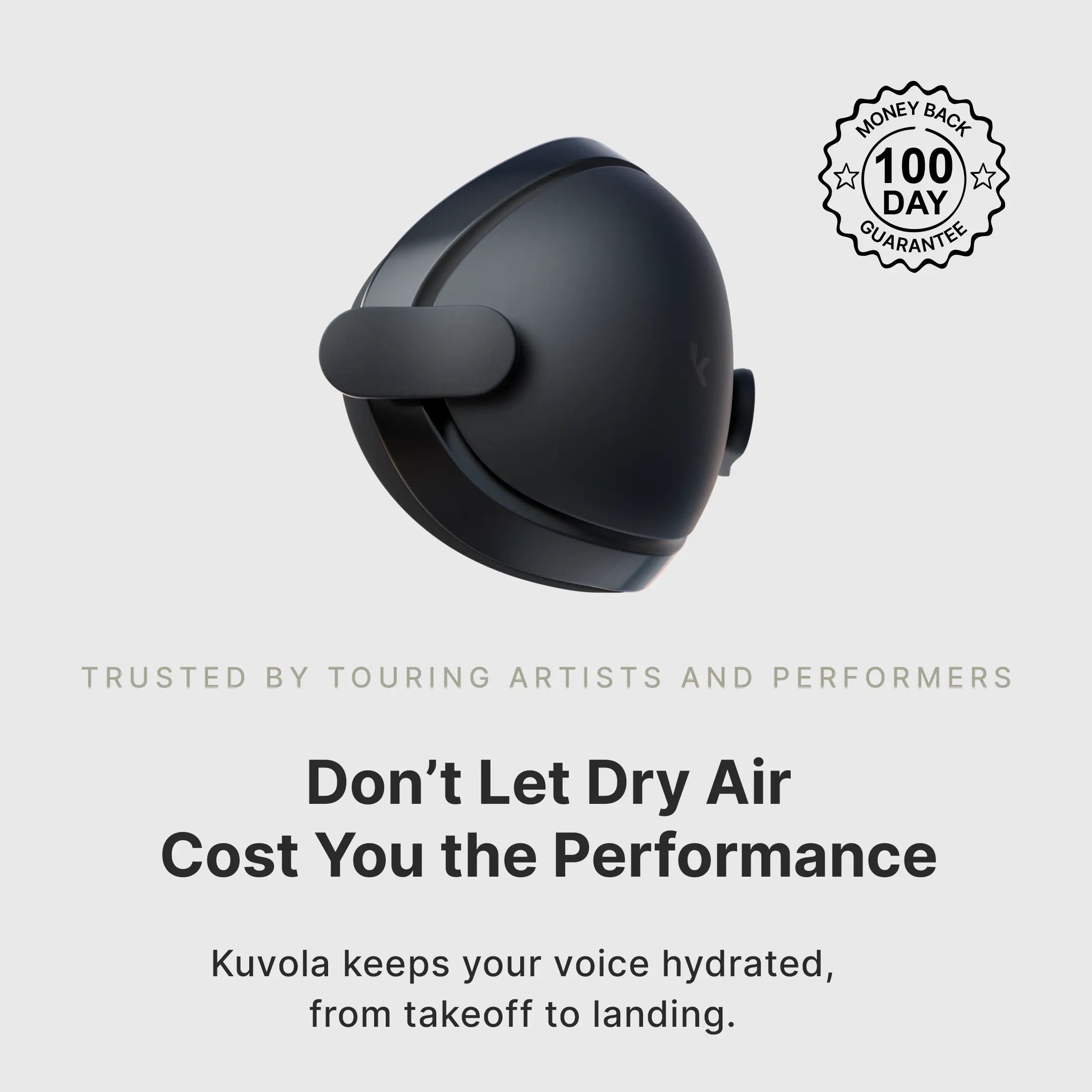
The missing piece
Built for the hours your steamer can't cover.
Kuvola captures moisture as you exhale and returns it to the fresh air you breathe in. HME technology, the same class used in medical respiratory care. No water tanks, no batteries, no electronics.
Put it on. Breathe normally. Sleep through the flight.
Your steamer handles the green room. Kuvola handles the plane.
100-Day Money-Back Guarantee
Hydrates your airways
Maintains the humidity your vocal folds need, even at cruising altitude.
Protects your range
Lower phonation threshold pressure. Your extremes stay accessible.
Works while you sleep
Put it on, recline, breathe naturally. Real hydration meets real rest.
Completes the kit
Your steamer. Your throat coat. Your vocal rest. Now your in-flight air.
How Kuvola fits in
| Kuvola | Drinking water | Portable steamer | Regular mask | |
|---|---|---|---|---|
| Hydrates airway surface directly | ✓ | ✗ Takes 2-4 hours | ✗ Not available in-flight | ✗ Traps stale air |
| Works while sleeping on a plane | ✓ | ✗ | ✗ Needs power and refilling | ✓ Partial |
| No setup or refilling | ✓ | ✗ | ✗ | ✓ |
| Engineered for optimal humidity | ✓ | ✗ | ✓ Room only | ✗ |
| Travel-ready design | ✓ | ✗ N/A | ✗ Bulky | ✗ Medical look |
The cost of not protecting your voice
Every touring season, more names join the list. Canceled tours or shows after vocal fold injuries.
The vocal coaches and ENTs who treat these injuries circle back to the same recommendation: keep the folds hydrated. Especially when you fly.
Common questions
That helps systemically, but it takes 2-4 hours for water to reach the vocal fold surface. Kuvola works directly on the air you breathe, hydrating your airways in real time. They work together.
Kuvola isn't a replacement for your steamer. It covers the gap your steamer can't: the 6-12 hours on a plane when you have no access to steam, no power, and no way to set up. Your steamer handles the dressing room. Kuvola handles the flight.
A regular mask traps some exhaled moisture incidentally. Kuvola uses HME (Heat and Moisture Exchange) technology, manufactured in the UK. The same class used in respiratory care, designed to maintain the humidity range your airways need. Fresh air in, humidified air out.
It's a premium travel accessory, designed in Stockholm. More Rimowa than medical supply. It signals that you take your instrument seriously.
Do you fly for auditions? Between tour cities? Home for holidays during a run? Even one dry flight before a Monday show can affect your whole week. And hotel HVAC is just as dry. Kuvola works anywhere the air isn't.
For those who can't risk their voice, energy, or performance.

Hydrated vocal folds
Clear voice with full range
Protected resonance and tone
Vocal stamina

100-Day Money-Back Guarantee → Hydrated comfort, or your money back.

Ships from our warehouse in Sweden
Choose options

Designed in Sweden
Scandinavian Design.
Universal Comfort.

Fast Delivery
Fast and secure delivery.
No hidden fees or surprises.

Ideal Gift for Travelers
Give a fellow traveler the gift of a comfortable journey.

Top Rated
Trusted by discerning travelers around the world.